Examination Results
GCSE Performance 2025
Academy Performance Tables - gov.uk
GCSE Headlines
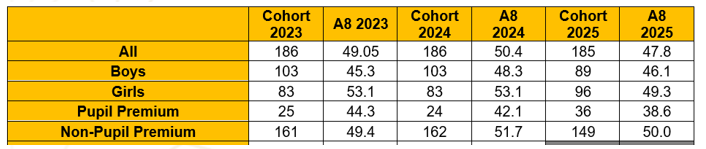
Our GCSE Headlines outline that our overall Attainment 8 score was 47.8. This measure is above the national standard but slightly down on last year. The attainment of both boys and girls was slightly lower than previous years. The performance gap between boys and girls has closed to 0.5 of a grade. This is the smallest gap we have had for the last 3 years. To overall attainment of Non-Pupil Premium students was 50 v 38.6 for Pupil Premium students. The attainment score for Pupil Premium students is the lowest we have achieved. However, there are a number of contextual issues with some of our Pupil Premium cohort which will have impacted on this attainment score.
Basics Measure (English and Mathematics combined)
Our 5+ Basics measure was 45% and our 4+ Basics measure was 70%. Both measures are above the national average but slightly down on our previous performance for this measure.
Best English Summary
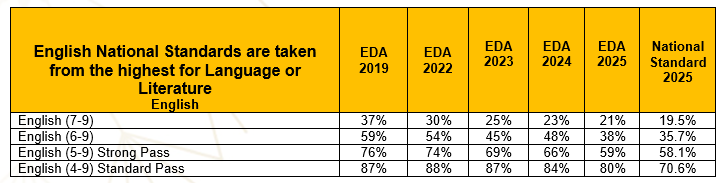
Our best English attainment percentages are in line with or above the National Standard for 2025. However, our English Language results demonstrate a slight decline for the first time since the GCSEs were reformed in 2016. Comparative to the national picture, our English Language results demonstrate that (Grades 7-9 10% v 19.5%, Grades 6-9 28% v 35.7% and Grades 5-9 47% v 58.1%). English Language results at Grades 4-9 are at the National Standard 70% v 70.6%. Competitively, and with the students having the exact same teacher for English Language and English Literature, the English Literature grades were better when comparing our performance with the National Standard (Grades 7-9 17% v 20.3%, Grades 6-9 34% v 38.7%, Grades 5-9 52% v 54.2% and Grades 4-9 77% v 74.2%).
Mathematics Summary

The overall performance of Mathematics has dropped slightly at the top end of the grading spectrum. Grades 7-9 comparative performance against the national standard was 15% v 21.5% and grades 6-9 comparative performance against the national standard was 26% v 33.2%. At the Government definition of a Strong and Standard pass, we have performed in line or better than the national standard (Grades 5-9 52% v 52.8% and Grades 4-9 76% v 71.9%).
Disadvantaged Student Summary (English and Mathematics)
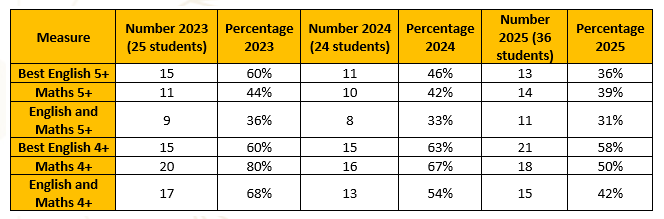
The number of students achieving each measure has increased. However, due to the greater number of students in the Disadvantaged student cohort, the percentages have decreased slightly. The overall attainment score for the Disadvantaged cohort is significantly impacted by 6 students. However, this is a clear focus for the 2025-26 academic year.
SEND Attainment

This data outlines the performance of SEND (EHCP and K) students against the non-SEND students.
Student performance in other subjects
Grades 7-9
At the top end, we have performed comparatively well (at or in line within 5%) against the national standard in Combined Science, Triple Sciences, English Literature, Art, Music, Geography, History, French, German and Sociology.
Grades 6-9
At grades 6-9, we have performed comparatively well (at or in line within 5%) against the national standard in Combined Science Biology, Chemistry, English Literature, Business Studies, Photography, Music, Geography, History, French, German and Sociology
Grades 5-9
At grades 5-9, we have performed comparatively well (at or in line within 5%) against the national standard in Combined Science Biology, Chemistry, English Literature, Mathematics, Computing, Art, Music, Geography, History, French, German, PE and Sociology
Grades 4-9
At grades 4-9, we have performed comparatively well (at or in line within 5%) against the national standard in Combined Science Biology, Chemistry, Physics, English Literature, English Language, Mathematics, Business Studies, Computing, Art, Photography, Music, Geography, History, French, German, PE and Sociology
Plans for Year 11
- Assemblies each Monday morning focusing on revision and study strategies
- Tuesday morning tutor period involving “Transformational Tuesdays” which includes follow-up from the assembly and other key information to support the week
- 2 x English/Maths/Science intervention sessions per week in morning tutor period
- After-school intervention programme for Science, RE and Option subjects beginning W/B 29th September which will run until Christmas. Disadvantaged students who underperformed are priority
- Information evening for Y11 parents/carers on how they can best support their children with their studies (8th October)
- Key students allocated to members of SLT/CD to support
- Meet the tutor evening to enable Y11 form tutors to meet the parents/carers of key students of concern
- Y11 PP students to have support from “keyworker” member of staff including meetings with parents/carers
- Blocked time (e.g. morning or afternoon sessions) for subjects which have elements of Non-examined assessment (NEA) as part of their course
- Half-termly newsletter informing parents/carers of what is going on with Y11 students and how they can best support
- Dedicated part of EDA Website – Y11 Revision with revision and exam board information including up to date PLCs
- Provision of opportunity to order revision guides at discounted rate via the Academy
- Y11 Lunchtime Support/Revision space 3 days a week (Tuesday, Wednesday and Thursday in RM42)
- Easter-school revision sessions
- Residential revision weekend
- Blocked time (e.g. morning or afternoon sessions) for Maths and English ahead of final examinations
- Revision “Booster session” timetable to support alongside final examination timetable
Academy Performance Tables - gov.ukThe attached is a summary of the outcomes achieved in the 2024-25 academic year. All of the data included in these results does include the outcomes any reviews of marking. In addition, the data outlined below is unvalidated at this point. Finally, all comparisons made need to be treated with a degree of caution as we did not have any starting points (Key Stage 2 data) for this cohort.
Results Analysis – Valued Added at Subject Level
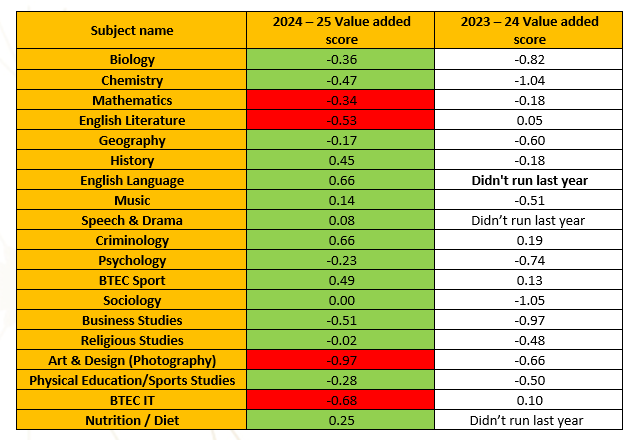
(Green indicates an improvement in Value Added compared to last year. Red indicates a decline in the Value Added for last year)
Value Added Subject Level
The following subjects have achieved a positive value added for 2024 – 25; History, English Language, Music, Drama, Criminology, BTEC Sport, Sociology and Food and Nutrition. The following subjects improved their value added compared to 2023-24; Biology, Chemistry, Geography, History, Music, Criminology, Psychology, BTEC Sport, Sociology, Business Studies and PE. Subjects where the value added has not improved are Mathematics, English Literature, Photography and BTEC IT.
Attainment Improvements at Subject Level
- 9 subjects (Business Studies, History, Music, PE, Physics, Psychology, Sociology, BTEC Performing Arts and BTEC Sport) improved their A*-B percentage compared to last year.
- 15 subjects (Business Studies, Chemistry, Criminology, Geography, History, Music, PE, Physics, Photography, Psychology, Sociology, BTEC IT, BTEC Sport, BTEC Performing Arts and Food and Nutrition) improved their A&-B percentage compared to last year.
Students who achieved a U grade.
- Student 1 (1 U Grade) – achieved 2 Bs in her other A Level subjects but found Chemistry very challenging. Intervention received for over 3 months.
- Student 2 (2 U Grades) – this was an overseas student who joined after the term has begun in Year 12. She had no previous experience of English schools. Intervention was completed in both of these subjects. She has no prior attainment so will not be included in the progress measures.
- Student 3 (1 U Grade) – this was our lowest prior attaining (3.7 grade average at GCSE) student at GCSE. He completed 2 vocational subjects and required an E grade to add positive value given his starting point but fell just short.
- Student 4 (2 U Grades) – lacked any effort throughout the whole of the two-year courses. Poor parental support. Offered all of the support we could.
- Student 6 (1 U Grade) – this student joined from another local school. Achieved a grade D and E in his other A Levels. His attendance became an issue in the Spring Term and he lacked any support from his parents. intervention offered beyond curriculum time but this was sporadically attended.
- Student 7 (1 U grade) – lacked engagement. Family were supportive but struggled with the practical element of A Level PE. As such, due to the weighting element, he did not achieve a grade.
- Student 8 (1 U Grade) – achieved a grade C and E in his other A Levels. Significant mental health concerns throughout his Sixth Form journey. This resulted in poor attendance.
Plans for Year 13
The information below outlines the plans for Year 13 regarding their first assessment point.
Assessments starting 13 October.
Pre-Assessments:
- Summer reading/tasks to address gaps in knowledge identified in end of year knowledge tests.
- Study planning as part of the tutor programme.
- Introduction of the 2357 revision planning strategy.
- Bespoke revision strategy session via weekly meeting schedule.
Post-Assessments:
- QLA at subject level with class misconceptions addressed within lessons.
- Progress review meetings for subject leaders with BM/PW.
- Subject-based interventions identified and implemented for students behind target within a subject.
- Tutor mentoring programme for students who are behind target in two subjects.
- Head of Sixth Form mentoring programme for students behind target in 3 subjects.
- Additional independent work for students who are behind target following an assessment.